
Understanding why melasma behaves differently from other pigmentation is the first step in choosing the right approach for your skin
Pigmentation is one of the most common concerns I see in the treatment room, but it’s also one of the easiest skin concerns to oversimplify.
A client may come in pointing to brown patches on their forehead or cheeks and say, “I just want these sun spots gone.”
Sometimes that’s exactly what we’re looking at. Other times, it’s melasma.
And that distinction matters.
Melasma doesn’t behave like a typical sun spot. You can’t simply choose the strongest pigmentation treatment, remove what you see and assume the problem is solved.
After years of treating pigmentation, one of the biggest things I want clients to understand is that melasma requires a different approach.
First, Is It Actually Melasma?
Not every brown spot is melasma.
Sun damage, post inflammatory pigmentation and melasma can all create areas of discolouration, but they don’t necessarily behave the same way or respond to the same treatments.
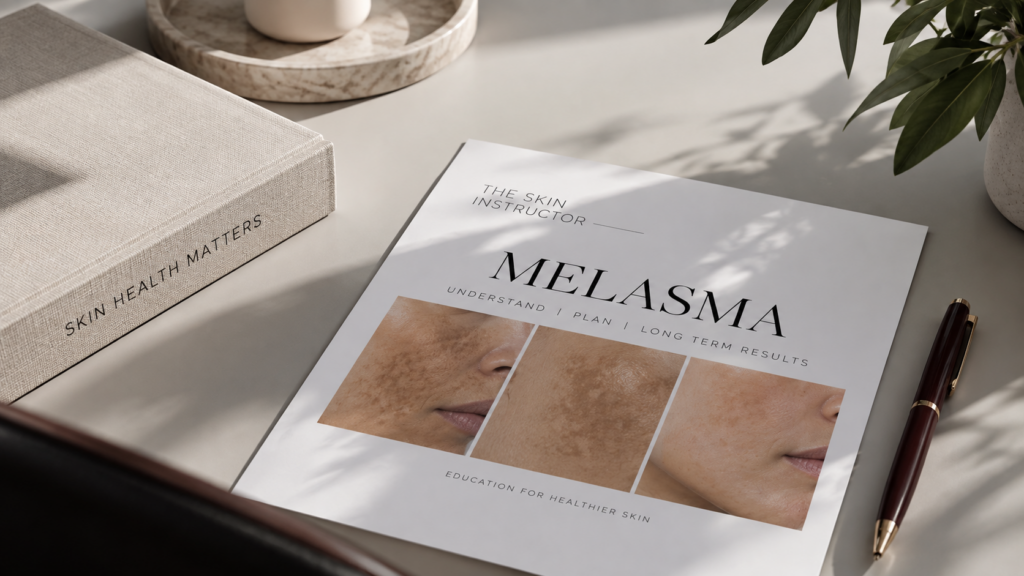
Melasma commonly appears as patches of brown or grey brown pigmentation, often across the cheeks, forehead, upper lip and sometimes the nose. It also tends to appear fairly symmetrically on both sides of the face.
This is why identifying the type of pigmentation matters before deciding what to do about it.
What worked beautifully for someone else’s sun spots may not be the right approach for your skin.
Why Did My Melasma Show Up Now?
This is one of the most common questions surrounding melasma, especially when someone feels like it appeared out of nowhere.
Hormones are a major reason melasma can suddenly become noticeable. Pregnancy is a common time for it to first appear, which is why melasma is sometimes referred to as the “mask of pregnancy.” Hormonal medications can also be associated with it.
Sun exposure is another major factor.
You may notice your melasma becoming much more noticeable during the summer and then fading somewhat during the winter. Even after you’ve achieved significant improvement, increased light exposure can cause it to become more visible again.
Visible light can also contribute to melasma, which is another reason daily protection is so important for people who are prone to it.
Heat may be a trigger for some people as well.
This is part of what makes melasma so frustrating. There isn’t always one single cause you can remove and suddenly have the pigmentation disappear.
Why Melasma Can Be So Frustrating to Treat
One of the reasons melasma can be frustrating is that what you see on the surface is only part of the story.
You may see the pigmentation lighten significantly and think it’s finally gone, only to notice it becoming darker again after a summer outdoors, a sunny vacation or another hormonal change.
That doesn’t necessarily mean something went wrong. It’s part of the behaviour of melasma.
This is also why trying to remove the visible pigment as aggressively as possible isn’t always the answer. Melasma prone skin can respond to irritation and inflammation by producing more pigment, so overly aggressive treatment can sometimes make the condition more difficult to manage.
With melasma, I think it’s much more helpful to focus on control and long term improvement rather than trying to erase every bit of pigment as quickly as possible.
Why Does Melasma Keep Coming Back?
This is probably the part clients find most frustrating.
You can see a significant improvement and still have melasma become noticeable again later.
The reason is that improving the pigmentation you can see doesn’t necessarily remove the tendency for your skin to develop melasma.
Hormonal influences may still be present. Your skin is still exposed to light. Different triggers can cause pigment production to become more active again.
That’s why I prefer to talk about managing melasma rather than curing it.
For some people, it may remain very well controlled for long periods of time. For others, it may fluctuate throughout different seasons or stages of life.
Understanding that from the beginning can make the entire process much less frustrating.
Your Daily Routine Plays a Bigger Role Than You May Think
When it comes to melasma, what you’re doing at home is just as important as the treatments you’re having done in clinic.
The first thing I always come back to is sunscreen. If you’re trying to improve melasma but you aren’t protecting your skin consistently, it’s going to be very difficult to keep the pigmentation under control.
I also like tinted sunscreens with iron oxides for melasma because they can provide additional protection from visible light, which can contribute to pigmentation.
Then we have ingredients that can actually help target pigment.
Some ingredients I like to look for in a melasma routine include tranexamic acid, azelaic acid, kojic acid, vitamin C and niacinamide.
Retinoids can also be helpful because they support skin cell turnover and can be incorporated into a pigmentation focused routine when appropriate.
Hydroquinone is another ingredient that can be very effective for melasma, but it’s something I would use more intentionally and with professional guidance rather than treating it like an everyday brightening serum.
And you definitely don’t need all of these ingredients in your routine at once.
With melasma, irritating the skin by using too many strong products can actually work against you. I would much rather see someone using a few well chosen products consistently than layering every pigmentation ingredient they can find.
Where Do Professional Treatments Fit In?
This is where treating melasma becomes very individualized.
There isn’t one treatment that I would automatically recommend to every person with melasma. The treatments I choose depend on the skin, how reactive it is, the pigmentation I’m seeing and what that person has already tried.
There are, however, a few professional treatments that can have a place in a melasma treatment plan.
Pico Laser
Pico lasers are one option that can be used when treating pigmentation, but they work a little differently than many of the lasers people may be familiar with.
The name “pico” refers to how quickly the laser delivers its energy. Pico lasers deliver extremely short pulses of energy measured in picoseconds, which are trillionths of a second.
Some other lasers rely more heavily on heat to create a controlled response in the skin. Pico technology delivers its energy incredibly quickly, creating more of a photoacoustic effect that helps break pigment into much smaller particles that the body can gradually clear.
This is one of the reasons pico lasers can be such a useful tool for pigmentation.
But melasma is different from simply treating an isolated sun spot.
With melasma, I’m still very cautious about how the skin is treated because too much inflammation can potentially stimulate more pigmentation. The fact that a pico laser can target pigment doesn’t automatically mean every person with melasma should have one.
For the right client, pico laser treatments can be incorporated into a larger melasma treatment plan, but the laser itself is only one piece of it.
With melasma, it’s less about finding the strongest laser and more about choosing the right treatment for the skin in front of you.
Chemical Peels
Chemical peels are another option I may use for melasma.
A properly selected peel can help with surface pigmentation and skin cell turnover while also working alongside the pigment targeting ingredients someone is using at home.
The important part is choosing the right peel.
I don’t believe in choosing the strongest peel possible just because we’re trying to treat stubborn pigmentation. With melasma, creating too much irritation can sometimes lead to more pigmentation, especially in skin that is already reactive.
The type of peel and strength should always make sense for the person’s skin.
Microneedling With Mesotherapy
Microneedling with mesotherapy is another treatment I like for certain cases of melasma.
This is a little different from simply performing microneedling for collagen stimulation.
During microneedling, we create controlled microchannels in the skin. When we pair the treatment with an appropriate professional mesotherapy solution, we can incorporate ingredients specifically selected to target pigmentation.
For example, tranexamic acid may be included in certain professional mesotherapy formulations used for pigmentation.
So in this case, we aren’t relying on microneedling alone to improve melasma. The microneedling and targeted mesotherapy are being used together as part of the treatment.
This is also why I’m very particular about what is used during microneedling. You cannot take any brightening serum from your skincare routine and assume it is appropriate to microneedle into the skin. The formulation needs to be appropriate for professional use with that treatment.
It Usually Isn’t One Treatment
This is probably one of the biggest things I want people to understand about treating melasma.
I rarely look at it as, “Which treatment is going to get rid of this?”
I’m looking at the entire picture.
What are you using at home? Are you protecting your skin every day? Are there triggers we need to consider? What type of pigmentation am I actually looking at? And then, which professional treatment makes the most sense for your skin?
For one person that might include a chemical peel. For someone else it may be microneedling with mesotherapy or carefully selected pico laser treatments.
The goal isn’t to throw every treatment at melasma.
It’s to create a plan that improves the pigmentation without constantly triggering it in the process.
The Right Approach Starts With Understanding Your Skin
Melasma is one of those skin conditions where understanding what you’re treating really does matter.
Two people can have pigmentation that looks similar and still need completely different treatment plans. That’s why I don’t believe in choosing a treatment simply because it targets pigment.
For me, treating melasma is about looking at the entire picture. The type of pigmentation, your skin type, how reactive your skin is, possible triggers, what you’re using at home and what treatments make sense for your skin all play a role.
Pico laser, chemical peels and microneedling with mesotherapy can all be great tools when they’re used appropriately, but the treatment itself is only part of the equation.
If you’re dealing with melasma, the first step shouldn’t be deciding which treatment you want to book.
The first step is understanding your skin and making sure you’re treating the right condition in the right way.
That’s ultimately what gives you a much better foundation for improving melasma and maintaining your results over time.
Share this story